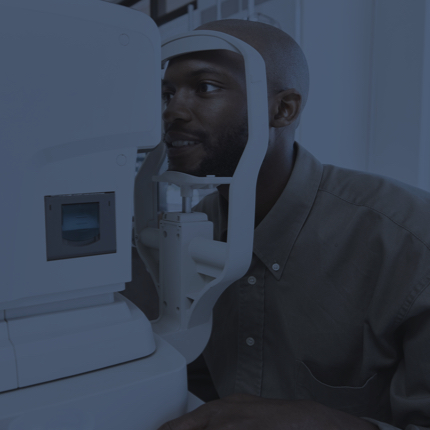

You might notice that straight lines suddenly look wavy, or that you need extra light to read your favorite book. These changes in your vision could signal age-related macular degeneration (AMD), a condition that affects millions of people over 50. While these symptoms might seem minor at first, they can point to changes happening in the most important part of your retina.
Early detection of AMD can dramatically slow the progression of vision loss and help you maintain your independence for years to come. When caught in its early stages, you have access to treatments and lifestyle changes that can protect your central vision and preserve the activities you love most. Cowichan Eyecare provides comprehensive screening to detect these changes before they significantly impact your daily life, using tools to identify early warning signs.
What AMD Does to Your Vision
AMD affects the macula, a small but important part of your retina that acts as the “detail centre” of your eye. This tiny area lets you read text messages, recognize your grandchildren’s faces, and see fine details clearly. When the macula begins to deteriorate, your central vision becomes blurry or distorted while your side vision typically stays clear.
You can still see movement around you and navigate rooms safely, but tasks requiring sharp focus become challenging. Reading price tags at the grocery store might require you to hold items farther away or closer than usual. Faces become harder to recognize until people get close enough for you to see them clearly.
The condition usually develops gradually over months or years, though wet AMD can progress more rapidly. Most people first notice changes in one eye, and the other eye often compensates initially. This natural adaptation can mask early symptoms, making regular eye exams even more important for catching changes before they affect your daily life.
Early Warning Signs You Shouldn’t Ignore
Visual Changes That Signal AMD
Your vision sends clear signals when AMD begins affecting your macula. These symptoms often start subtly but become more noticeable during activities that require detailed vision:
- Straight lines appearing wavy or bent when you look at door frames, telephone poles, or text
- Dark or empty spots in your central vision that block parts of what you’re trying to see
- Colors appearing less bright or vivid than they used to look
- Difficulty reading small print even with your usual glasses or contacts
- Trouble recognizing faces from a distance that you could see clearly before
- Need for brighter light when reading or doing close-up tasks
When These Symptoms Typically Appear
Most people develop AMD after age 50, with risk increasing significantly after 60. Early-stage dry AMD often produces mild symptoms that develop slowly over several years. You might notice slight changes in your vision during routine activities like reading or driving.
Wet AMD symptoms can appear more suddenly and progress faster than dry AMD. If you experience rapid changes in your central vision, distorted lines, or new dark spots, these changes need immediate attention. The type of AMD affects how quickly symptoms develop and what treatment options work.
Some people notice symptoms in just one eye initially, while others experience changes in both eyes around the same time. Your brain often adapts to gradual changes, which means you might not realize how much your vision has changed until you cover one eye and test each eye separately.
How Early AMD Care Supports Better Outcomes
MacuMira: An Advanced In-Office Therapy for Dry AMD
MacuMira is a non-invasive, in-office therapy designed for early to intermediate dry age-related macular degeneration. It uses gentle microcurrent stimulation through the closed eyelids to support the energy-producing structures inside your retinal cells. By helping these cells function better, MacuMira may slow changes in the macula and support clearer, more comfortable central vision.
MacuMira treatments are quick, painless, and require no downtime. Because the therapy is done by trained eye care professionals, each session is carefully controlled to target the macula safely and effectively.
Early results from patient studies are promising. Many people experienced noticeable improvements in their vision, including:
- Being able to read more than one full line farther down the eye chart
- Clearer, sharper reading vision
- Better ability to see contrast and fine details
- Less glare from lights, especially at night
Some patients begin noticing these improvements within just a few days or weeks of starting treatment.
Why Your Optometrist May Recommend MacuMira Early
MacuMira works best when dry AMD is still in the early stages. At this point, more of the macula’s cells are still healthy enough to respond to treatment. Starting early means the therapy can support these cells before more significant damage happens. Your optometrist will recommend MacuMira based on the stage of your AMD and how your retina responds over time.
Photobiomodulation (PBM) With Arunalight: At-Home Support
Photobiomodulation (PBM) is a separate therapy from MacuMira. PBM uses low-level red and near-infrared light to support cellular energy and reduce stress in the retina. Cowichan Eyecare may recommend Arunalight, an at-home PBM device designed specifically for the eyes, for patients who want an additional way to support their macular health between visits.
PBM tends to provide more modest improvements compared to MacuMira. Unlike MacuMira, patients generally do not see a full line of improvement on the eye chart with Arunalight. Instead, people often notice subtle changes, such as:
- Slightly sharper contrast
- Mildly clearer details
- A bit less visual strain or glare
Because it’s used at home, PBM can be a convenient add-on to your AMD care plan, but it is not a replacement for the more substantial results often seen with in-office MacuMira treatment.
Simple Tests You Can Do at Home
The Amsler Grid Test
The Amsler grid is a simple chart with intersecting lines that can help you detect early changes in your central vision. Hold the grid about 12-14 inches from your face in good lighting, cover one eye, and look at the center dot. The lines should appear straight and the squares should look equal in size.
If you notice wavy lines, missing sections, or blurry areas, these changes could signal problems with your macula. Dark spots or areas where the grid disappears can also indicate vision changes worth discussing with your eye care provider.
Test each eye separately once or twice a week, and keep track of any changes you notice. Many eye care offices provide Amsler grids for home use, or you can find printable versions online.
Other Quick Vision Checks
Cover one eye and try reading different sized text with the other eye. Notice if you need to hold books or newspapers closer or farther than usual, or if you need brighter light than before. Switch eyes and compare how easily each eye handles reading tasks.
Look at straight objects around your home, like door frames, window edges, or the lines between tiles. Cover one eye at a time and check whether these lines appear straight or if they look bent or wavy. Any distortion in straight lines deserves attention from your eye care provider.
Compare how colors look to each eye by covering one eye, then the other, while looking at brightly colored objects. Pay attention to whether colors seem dimmer, less vibrant, or different between your two eyes.
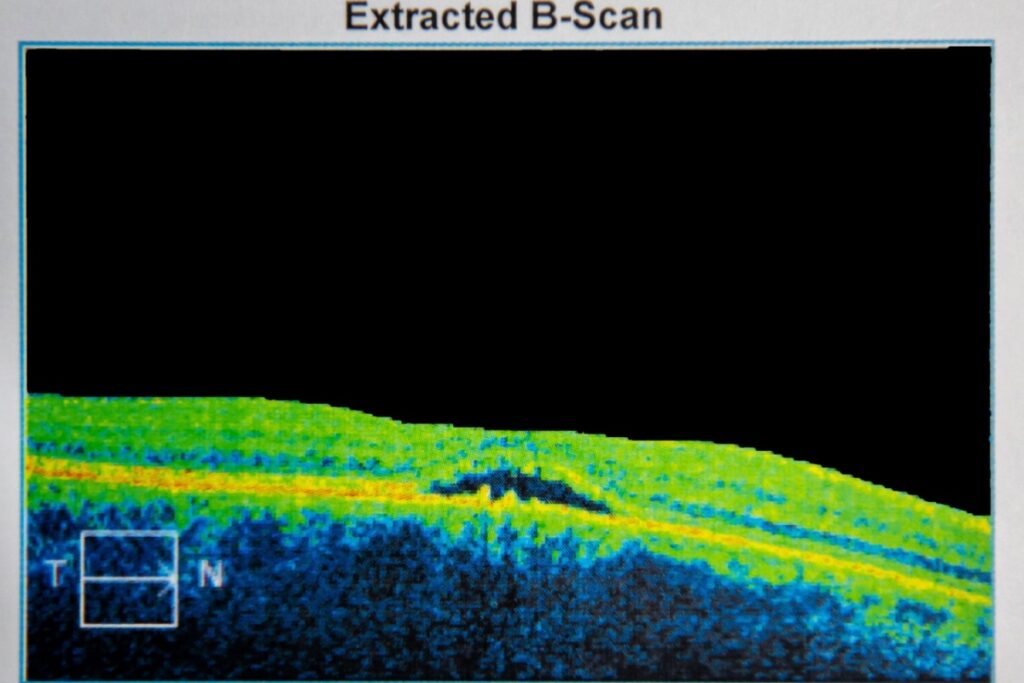
While these simple home checks can help you notice early changes, they don’t replace a professional exam. Dilated eye exams are especially important for detecting AMD, because dilation allows your optometrist to clearly examine the macula and spot subtle changes that aren’t visible through an undilated pupil. This detailed view is essential for diagnosing AMD in its earliest stages, when treatment works best.
Protecting Your Vision Starts With Regular Eye Exams
While simple home checks can help you spot changes, only a comprehensive eye exam can detect AMD early enough for treatments like MacuMira to make the biggest difference. Early detection allows your optometrist to track subtle changes in the macula and create a personalized care plan before your vision is significantly affected.
For many patients with early dry AMD, MacuMira offers a meaningful way to support clearer central vision and slow progression. Your optometrist may also recommend at-home options such as photobiomodulation with Arunalight for added support, but these therapies generally provide more modest improvements and work best as part of a broader care plan.
Staying proactive with regular exams gives you the best chance to maintain the independence and activities you love. If you are noticing new changes in your vision or are over 50, schedule a comprehensive eye exam with Cowichan Eyecare at one of our Vancouver Island locations to stay ahead of AMD.