You glance up at a bright, clear sky and notice something drifting across your vision. It moves when your eyes move, floats away when you try to look directly at it, and disappears just as quickly as it appeared. If that sounds familiar, you have likely experienced floaters.
Flashes and floaters are typically caused by age-related changes in the vitreous, the gel-like fluid that fills your eye, as it shrinks and interacts with your retina over time. They’re more common than people realize, and while they are often harmless, they could be a sign of something else going on.
Understanding Flashes and Floaters
Flashes and floaters are common visual changes that originate from inside the eye itself, not from anything in your environment.
Floaters: What You’re Seeing
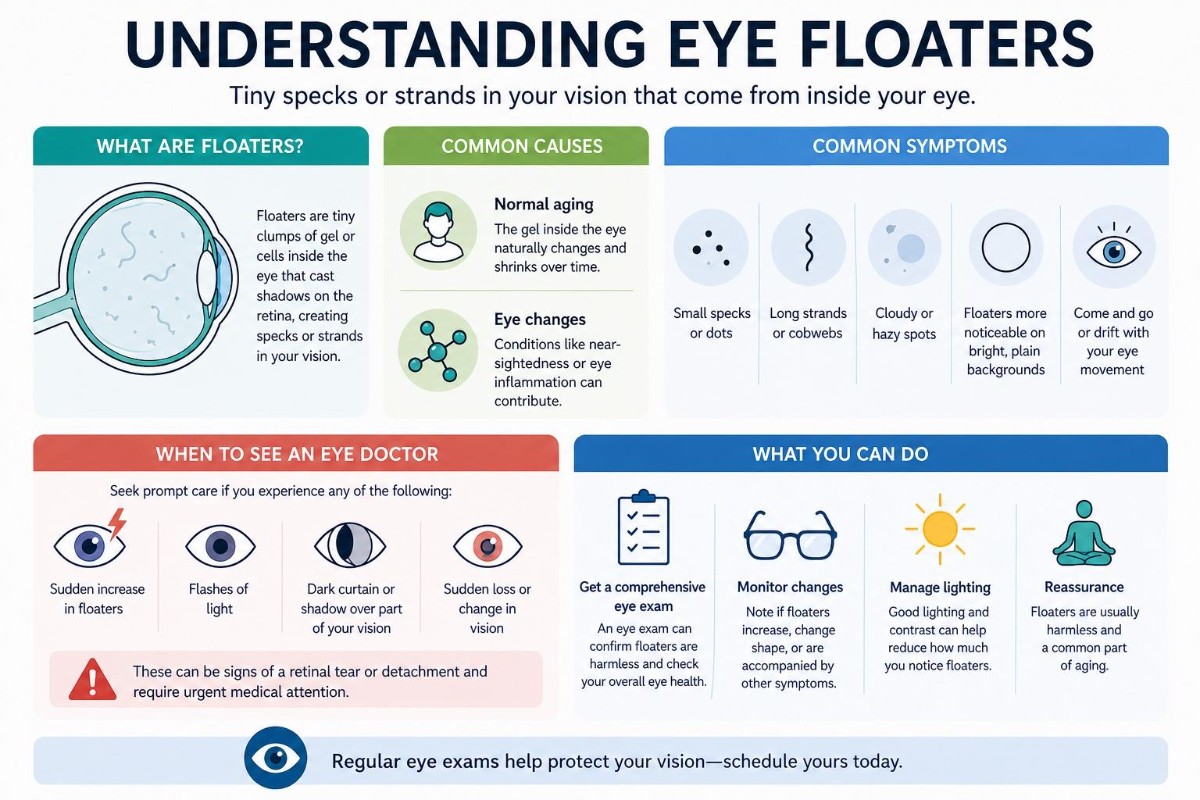
Floaters look like tiny specks, strings, or cobwebs drifting across your field of view. They are not actually floating on the surface of your eye. Instead, they are shadows cast by small clumps or strands that form inside the vitreous gel.
You’ll notice them most against a plain, bright background like a white wall, a sunny window, or an open sky. They move with your eyes, which is why chasing them with your gaze never works.
Flashes: Why They Happen
Flashes look like brief sparks or streaks of light, often at the corner or edge of your vision. They happen when the vitreous gel pulls or tugs on the retina, which is the light-sensitive tissue at the back of your eye.
This tugging sends a signal to your brain that your eye reads as light, even when there isn’t any. Flashes can appear on and off for several weeks as the vitreous settles.
Common Causes of Flashes and Floaters
The most common reason people develop flashes and floaters is simply the natural aging of the eye. Over time, the vitreous gel shrinks and begins to pull away from the retina. As it does, collagen fibres inside the gel can clump together and cast shadows on your vision.
This process, called posterior vitreous detachment, becomes much more common after age 50. It sounds alarming, but for most people it’s a normal change that doesn’t cause lasting harm.
Age isn’t the only factor. Eye inflammation, injury, or infection can also lead to floaters. Ocular migraines are another common source of light flashes, often appearing as shimmering arcs or zigzag patterns that fade on their own.
People with diabetes or those who’ve had cataract surgery may also notice these symptoms more often. Diabetic eye exams are designed to detect these changes early, before they affect your vision more significantly. Knowing your personal health history helps your optometrist put your symptoms in the right context.

Who Is More at Risk
While anyone can experience flashes or floaters, certain factors make them more likely. You may want to pay closer attention to these symptoms if any of the following apply to you:
- You are nearsighted, as the shape of a nearsighted eye can put more stress on the vitreous and is often associated with peripheral retinal thinning
- You are over 50 or have a family history of eye conditions
- You have a history of eye surgery or a previous eye injury
If you fall into one of these groups, regular eye exams become even more valuable for keeping track of any changes over time.
When Flashes and Floaters Need Attention
Most floaters are harmless, but certain changes in how they look or feel are worth taking seriously. Contact your optometrist promptly if you notice any of the following.
- A sudden increase in new floaters appearing all at once
- Frequent or persistent flashes of light
- A shadow, dark curtain, or grey area blocking part of your vision
- A loss of peripheral vision alongside other symptoms
These changes can sometimes point to a retinal tear or retinal detachment, which happens when the retina separates from the tissue behind it. This is a situation where getting your eyes checked quickly matters, as it could lead to permanent damage.
A posterior vitreous detachment with complications can also produce these kinds of symptoms. Schedule an emergency eye exam immediately if you experience these signs. Let an optometrist identify the issue and determine the right next step to protect your vision.
What an Eye Exam Checks For
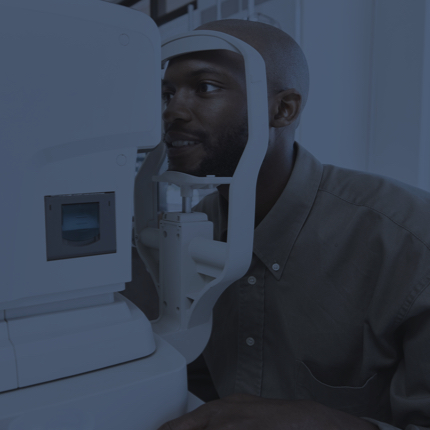
When you come in with concerns about flashes or floaters, your optometrist will examine your retina and vitreous in detail to figure out what’s going on. Cowichan Eyecare uses Optomap retinal imaging to capture a wide-field view of your retina without the need for dilation drops, along with OCT (optical coherence tomography) to see the retinal layers in fine detail.
These tools help your optometrist detect signs of posterior vitreous detachment, retinal tears, or other changes that wouldn’t be visible during a standard exam alone. In some cases, your optometrist may still recommend dilation for a closer look at specific areas, and they’ll explain why if it’s needed.
Stay on Top of Your Eye Health
Regular eye exams are one of the most reliable ways to track changes in your vision before they become bigger problems. Many conditions, including the ones that lead to flashes and floaters, respond much better when they’re found early.
Cowichan Eyecare proudly serves families across the Cowichan Valley and surrounding communities. Whether you’re overdue for a routine exam or you’ve noticed something new in your vision, the team is ready to help you get the answers you need.
Book your appointment today and give your eyes the attention they deserve.